
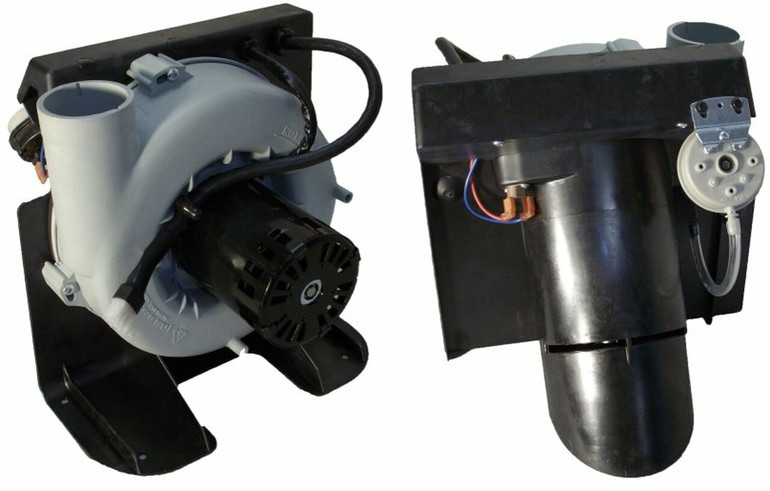
Motor Specifications and Features for the Fasco W3:
- Shaded Pole
- CFM 90
- 1/17 HorsePower (HP)
- 115 Volts
- 3000 RPMs
- Single Speed
- 1.7 Amps
- Thermally Protected
- CCW Rotations as Looking at the Shaft
- Ball Bearing
- 5 Pin Cord Attached (6 slots on the cord plug, but only 5 are being used)
- Wheel Size 7-3/16” x 1”
- 2 Wire Limit Thermostat Mounted on Housing
- Pressure Switch Mounted on Housing
How to Install a Power-Vented Water Heater
Operating and maintaining electric heaters is much more expensive compared to natural gas and propane Fasco water heaters.
If you install a natural gas Fasco water heater, it will be way easier to run the vent. This particular venting system is unique from other gas water heaters. Most water heaters contain a natural-draft type of venting system. In this case, the hot waste gasses rise through an open draft diverter, into metal pipes and then outside.
On the other hand, the power vented models require fans to blow all the exhaust gasses out. The vent pipes do not need to be in an upward position, since the method that these water heaters use does not necessarily rely on the natural buoyancy of hot air. The pipes can be put in a horizontal position, making them easier to install. Then, the fan dilutes the exhaust gasses with cooler air, which enables you to run the vents with an easy-to-assemble PVC pipe. Power venting is more suitable where there is a need for energy efficiency, as well as small spaces.
Drawbacks:
- The sound of the fan may be noticeable. To prevent this nuisance, the Fasco water heater can be installed in a room away from the main living area.
- You need a standard electrical receptacle near the unit to supply power for the fan.
- It is recommended to install the unit in an area where there is adequate “make-up” air that can replace the air being blown out.
- The power-vented water heaters are about 50 percent more expensive than a natural-draft water heater.
The installation process of the Fasco water heater fans is quite easy and you can carry out the experiment on your own as a DIY, provided you understand and follow all the instructions to the latter.
Problems and Troubleshooting
The Fasco water heater is essential for providing hot water for your bathroom and kitchen faucets.
Always remember to turn off the power supply at the circuit breaker before you begin working on your Fasco water heater.

Water Temperature Problems
Water temperature is the most common problem:
- Cold water
This is often caused by a lack of power and at times a faulty thermostat/heating element. You should first reset the tripped circuit breakers and replace any blown fuses to eliminate power being a problem. Then check the power switches to ensure that they are all turned on and that the power indicators are lit as they should be. Checking the thermostat should be next to verify that it’s receiving enough power.
- Water is not hot enough
The possible reason for this would be that your Fasco water heater is undersized, and the hot and cold water connections may be crossed. If the problem is beyond any of the ones mentioned, contact a professional to inspect all the water heating elements, thermostat, and to check whether the size of your water heater is the best fit.
- Water is too hot
Extremely hot water usually indicates that the thermostat is set too high. You can check your Fasco water heater owner’s manual to guide you on how to adjust the thermostat temperature to your desired one. The manual can also guide you on how to select the best balance of heat and its efficiency.
Leak Problems
These can be as a result of a couple of issues such as a faulty temperature and pressure relief valve, overheating, a valve that is stuck, leakage from a nearby plumbing connection, heating elements that are loose, a faulty gasket or a leaking water tank.
Check for a loose connection that may cause leaking. Then tighten them to eliminate the leaks.
There may be loose plumbing element bolts, check if they are loose and then tighten as needed.
If the heating element is still leaking, you will have to replace the gasket with a new one. There may also be leaks coming from around the storage tank. Water tank issues can easily be solved by switching to a tankless Fasco water heater. The tankless water heater usually lasts longer. These Fasco water heaters may also take up ¼ of the space in your basement.
Discolored Water
Water that appears rusty usually indicates that your tank's inner lining is corroded. The rust is usually caused when the anode rod fails. To determine if the anode rod needs to be fixed, you would need to contact a professional Fasco water heater technician. Otherwise, you have to replace your Fasco water heater with a new one.
Odd Noises
Odd noises that come from your water heater are a result of sediment build-up. You can also attempt to fix the problem by flushing the Fasco water heater. If the water heater still has a problem, or the sediment build-up is too difficult to remove, you replace your Fasco water heater.