
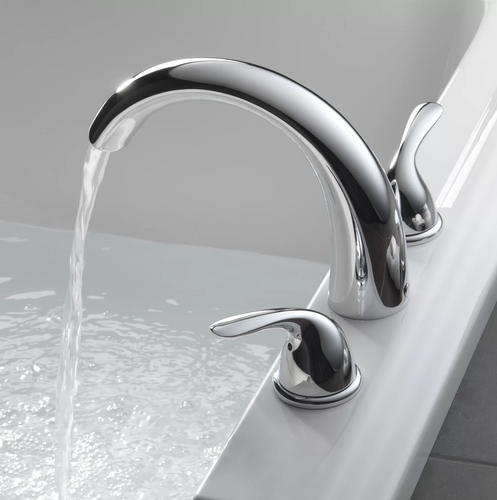
If you notice a leaking tap, a leaky valve, a broken spout, a broken handle, a cracked pipe, no water flow, and more problems coming from your Delta tub faucet… it may be time for a repair or a replacement!
How to Detect a Faulty Delta Tub Faucet
To find out if your Delta tub faucet is faulty, check the following:
- The temperature of your hot and cold-water supply — it could be too hot or too cold.
- The water pressure is out of place, as there could be too much or too little water coming out.
- The volume of water that goes down the drain could be too slow.
What are the different types of Delta tub faucets?
There are two main types of delta tub faucets: single lever faucets and double lever faucets.
Single Lever Delta Tub Faucets:

Single lever delta tub faucets are the most popular type of delta tub faucets. They consist of one control knob which controls both the hot and cold water supplies. These faucets are very easy to use and are quite affordable. However, they are not as durable as double lever delta tub faucet models.
Double Lever Delta Tub Faucets:

Double lever Delta tub faucets are very durable and powerful but are more costly than single lever Delta tub faucets. They have two separate knobs that control the hot water and the cold water supply independently.
Parts of a Delta Tub FaucetHere is a guide of the Delta tub faucet parts that will better your understanding of the faucet.
The Main Parts:


1. The Body:
This is the main part of the Delta tub. It holds everything together and provides support to all the other parts. It is made up of plastic and metal components. The plastic component includes the top plate, the bottom plate and the sides. The metal components include the frame, the mounting bracket and the brass fittings.
2. The Stem:
The stem is the central part of the Delta tub and it connects the body to the valve assembly. It also carries the flow of water from the valve assembly to the ballcock. The stem can either be threaded or unthreaded. Threaded stems are used for older models while unthreaded stems are used in newer faucet models.
3. The Ballcock:
The ballcock is the mechanism that regulates the flow of water into the valve assembly. It is located inside the valve assembly. The ballcock is usually controlled by a small hand wheel. When the hand wheel is turned clockwise, the ballcock opens and lets water pass through. When the hand wheel turns counter-clockwise, the ballcock closes and stops the flow of water.
4. The Handle:
The handle is the part of the delta tub where the user operates the system. The handle has several holes that allow air to escape when the water temperature changes. Some holes let out steam when the water gets too hot.
5. The Diverter:
The diverter is the device that allows the user to choose between hot and cold water. It is attached to the handle. Some models come with a diverter built right into the handle. Others have a separate diverter mounted on the handle. Either way, the diverter is connected to the valve assembly. When the diverter is turned clockwise, it directs all the water coming from the valve assembly towards the spout. When the diverter turns counter-clockwise, however, the water goes straight down the drain.
6. The Valve Assembly:
The valve assembly is the part of the faucet that controls the flow of water. It consists of three major components: the valve, the seat and the washer. The valve is the actual mechanism that controls the flow of water into and out of the faucet. The seat is the part that sits over the valve and keeps it closed.
How to replace a Delta tub faucet:
1. Remove the old faucet from the wall. If possible, remove any screws holding the faucet onto the wall. If not, use a screwdriver to pry off the faucet.
2. Disconnect the electrical wires from the faucet. You may need to disconnect them using electrical pliers.
3. Unscrew the nut that secures the valve assembly to the body.
4. Remove the two bolts holding the valve assembly onto the body.
5. Lift the valve assembly out of the body.
6. Replace the new valve assembly with the old one. Screw the nut back onto the body. Tighten the bolt securely.
7. Attach the electrical wire to the new valve assembly.
8. Re-attach the faucet to the wall.
Sometimes faulty Delta tub faucets may not show any signs at all. We highly advise you to have a professional check out and fix your Delta tub faucet.