
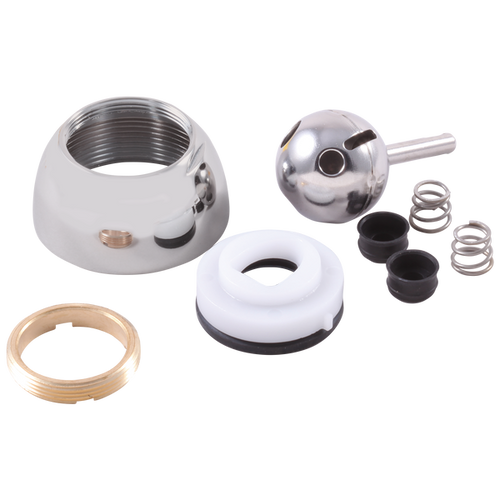
The Delta repair kit helps restore faucets that have a leaking problem. The worn-out parts of the faucet need to be replaced with new ones to create a better seal and prevent leaks.

The kit is suitable for single-handle faucets. The Delta faucet repair kit includes:
- The repair kit that can fit all Delta kitchen faucet models.
- All the parts are necessary to make repairs such as 1 cam and 5 o-rings.
- 2 short seats, 2 long seats, 2 long springs and 2 conical springs.
- A hex wrench that makes it easier to carry out the installation process.
- A single handle faucet repair kit.
- The faucet repair kit is complete for kitchen faucets.
- Compliant with the low-lead in drinking water act.
Things to do Before Repairing the Delta Faucet
If the water is warm when you place your hand under the drip that is on the faucet, the leak is most likely coming from the hot side of the kitchen faucet. In any case, it is recommended that you replace both of the faucet’s valves.
Locate the shutoff valve that is under the sink. The valve is characterized by either a knob, small ball-shaped handle or a lever. Identify the type that you have and then shut it off by turning it clockwise until it no longer moves. To make sure that the valve is shut off, open the hot and cold water faucets.
In the case that there is no shutoff valve, it is recommended to shut off the valve to the main water supply in your home.
Tools
Adjustable wrench or tongue-and-groove
Allen wrench or screwdriver
Two sets of rubber seat and spring
Plumber’s grease
New stem
1. Remove the faucet handle

Use a screwdriver to loosen the handle of the faucet. If it has a set screw, use an Allen wrench to loosen it. Remove the handle from the faucet stem by lifting and pulling it. Pry off the decorative cap from the top of the faucet handle so that you can have access to the screw on the handle.
2. Remove the bonnet nut
A bonnet nut is what secures the faucet stem. Loosen it using an adjustable wrench. Remove the stem from the faucet completely by unthreading it.
3. Remove the faucet stem
Identify the position of the stem in your faucet before you remove it. The identification process is important for when you reinstall it back to its original position. The stems contain one or more tabs that fit inside the stem housing to align the stem. Taking a photo of the stem would be helpful when you need a reference.

Pull the stem straight from its housing to remove it. You may need a pair of pliers to grip the spindle that is at the top of the faucet stem.
4. Remove the valve seat and spring
Inspect the stem housing to locate the neoprene valve seat inside a hole that is at the bottom of the housing. The valve seat is characterized as a small black rubber cap that has a hole at the top.

There is usually a small metal spring below the seat. Use a small screwdriver to remove the valve seat and spring from the hole of the seat and pull both of those parts out together. Note the orientation of the springs that are inside the valve seat. The spring is larger in diameter at the bottom than it is at the top, which fits inside the seat. The new spring and seat have to be installed in the same orientation as the old ones.
5. Install the new seat and spring
Attach the seat and spring at the end of the screwdriver or Allen wrench in the same orientation as the old seat and spring. Guide them into the hole of the stem housing using the same Allen wrench. The assembly must fit down the hole. To confirm that the valve seat is in the correct position, remove the Allen wrench to confirm.
6. Reinstall the stem
Apply some plumber’s grease onto the O-ring, particularly at the valve stem. You can replace the O-ring or the stem with brand new ones. Align the tabs on the stem with the slots that are in the housing to fit it properly. Push the stem until it cannot go any further. Put the bonnet nut back on and tighten with a pair of pliers. Be careful to not over tighten the nut, to avoid damaging the stem housing.
7. Check for possible leaks and reinstall the handle
Open the shut-off valve to turn the water back until the valve cannot turn any longer. Check for leaks. If there is a leak at the stem, tighten the bonnet nut until there is no longer a leak. Be careful not to damage the parts by over-tightening them. Secure the handle onto the stem using the setscrew.