
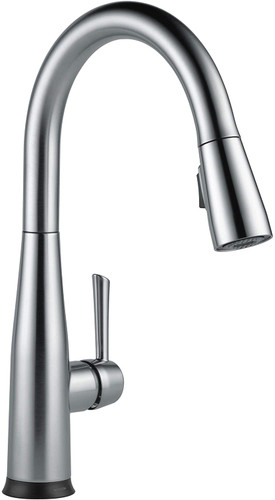
Delta kitchen and bathroom faucets with two handles are usually stem-style faucets. This includes a neoprene spring and valve seat that fits into the water inlet port in the valve body. This is different from an ordinary cartridge-style faucet that looks like a stem faucet but does not come with springs and valve seats.
For stem-style faucets, the stem is held in place over the valve seat and spring using a bonnet nut, while the handle fits onto the top of the stem.
You can fix leaks in this faucet with a new neoprene valve seat and spring. You may be required to replace the whole stem if there is a leak around the handle, if the handle is hard to turn, or if replacing the spring and the seat does not fix the leak.
Why Does My Delta Faucet Keep Dripping?
Dripping in a Delta faucet after replacing the cartridge can result from several reasons. The cause will depend on the type of cartridge you have, the water quality, and the age of your faucet. In most cases, the reason why a cartridge-style faucet leak is not completely connected with the cartridge itself.
Water Quality
Believe it or not, water is the most corrosive liquid around. The water running through the brass body of your faucet is full of calcium and other minerals that can corrode and wear away the brass. The water easily removes soft areas and small bumps, forming rivulets on the surface.
Such rivulets are not visible with naked eyes as they mix with the coatings left on the surface. Sometimes, for you or your plumber to fix a leaky faucet, you need to buff out the inside of the cartridge cylinder to expose the dark line that allows you to see the rivulets using a flashlight.
Damaged Components
Damaged internal components are other causes of a leaky cartridge. There is a brass, rubber, or ceramic seat located at the base of the cartridge opening. The seat is used to form a watertight seal. Once the seat no longer fits well in the hole due to age or other components, the faucet will leak.
Since the cartridge rests on the O-ring, the ring can have small cracks or defects that cause dripping or leakage on the cartridge. Once you decide to replace a particular component of your faucet, it is advisable to replace all the internal components. If you replaced the faucet cartridge and there is still a leak, there could be a problem with a different internal component.
How to Fix a Leaky Faucet Cartridge
Before you start, place your hand beneath the drip from your faucet to detect the nature of water coming out. If the water is cold, it means the leak is on the cold side of the faucet and if warm, it is likely to be on the hot side. This helps know which side it should be fixed first, but chances are both sides are leaking. Regardless of which valve wears out faster, it is wise to replace both of them simultaneously.
Locate the shutoff valve on the faucet and turn it off. The valve has a small football-shaped knob, handle, or lever. Turn it clockwise until it cannot turn anymore. Open the cold or hot faucet to ensure the water is off.
If the faucet has no shutoff valves, turn off the water from the main shutoff valve, then open the cold and hot water to release pressure in the supply lines.
Before you start, place your hand beneath the drip from your faucet to detect the nature of water coming out. If the water is cold, it means the leak is on the cold side of the faucet and if warm, it is likely to be on the hot side. This helps know which side it should be fixed first, but chances are both sides are leaking. Regardless of which valve wears out faster, it is wise to replace both of them simultaneously.
Locate the shutoff valve on the faucet and turn it off. The valve has a small football-shaped knob, handle, or lever. Turn it clockwise until it cannot turn anymore. Open the cold or hot faucet to ensure the water is off.
If the faucet has no shutoff valves, turn off the water from the main shutoff valve, then open the cold and hot water to release pressure in the supply lines.
Tools and Materials
- Tongue-and-groove pliers
- Adjustable wrench
- Screwdriver or Allen wrench
- Plumber's grease
- New rubber spring and seat
- Replacement stem
Step 1: Remove the Faucet Handle
Rotate your faucet handle counterclockwise to loosen it and use either an Allen wrench to remove the set screw on the side or a screwdriver to remove the screw on top of the faucet handle. Lift the stem straight up to remove the handle from the faucet.
Step 2: Remove the Bonnet Nut

Release the bonnet nut holding the faucet stem in place. Using an adjustable wrench or tongue-and-groove pliers, turn the nut counterclockwise to unthread it completely and detach it from the stem.
Step 3: Remove the Stem

Mark the position of the stem before disconnecting it. You should fix it back exactly in the same position. Otherwise, the faucet may not work properly. Stems usually come with one or more tabs that fit into the housing notches to allow you to align the stem. It would be better to take a photo of the stem for reference.
Pull the stem straight up and out of the housing. If possible, use pliers to grip the spindle at the top of the stem.
Step 4: Remove the Valve Seat and the Spring

Check inside the stem housing and identify the neoprene valve seat in a hole at the lower side of the faucet housing. The valve seat is a small, black, rubber cap. You will also see a small metal spring sitting inside and below the seat.
Insert the Allen wrench or a small screwdriver into the seat hole and pull up both parts simultaneously.
Check the spring's alignment inside the valve seat. The spring has a small diameter at the top, where it fits into the seat, then at the bottom. The new seat and spring must be installed with the same alignment.
Step 5: Fix the New Seat and Spring
Use an Allen wrench or a screwdriver to fit the spring and the seat in the same position as the original spring and seat. Using the same tools, guide the spring and the seat into the corresponding hole in the stem housing. Once they are fitted down into the hole, remove the wrench or screwdriver and check if the valve seat is well-positioned.
Step 6: Reinstall the Stem
Spread some plumber's grease to the O-ring. If necessary, you can replace the O-ring or the whole stem. Insert the stem into its housing as you align the tabs on the stem and the slots in the housing. Push the stem down until it cannot move anymore.
Reinstall and tighten the bonnet nut carefully using an adjustable wrench or pliers. Do not over tighten them as this can destroy the housing.
Step 7: Check for Leaks and Fix the Handle
Turn on the water supply by opening the shutoff valve or the main water supply at the faucet. Check around the faucet stem for leaks. If there is any, tighten the bonnet nut again to stop the leaking; again, do not over tighten it.
Reinstall the handle onto the stem and tighten it using a set screw or screw.
Final Thoughts
Delta is one of the renowned faucets brands due to the excellent support they provide to their customers. They provide an unlimited warranty on all parts to the original owner, making it easier to carry out maintenance on your own.
Such repairs cost a lot, but having the basic repair techniques, you can do it by yourself and save some coins. Remember, fixing a leaking faucet won't take long and won't cost you anything.
Our Delta products are one of the most popular products we carry. Find more Delta faucet products here!
Robert Syengo is an experienced web writer with a home improvement history that includes toilet remodeling and appliance installation. He enjoys writing and learning about electronics, gardens, design, remodeling and repair.