
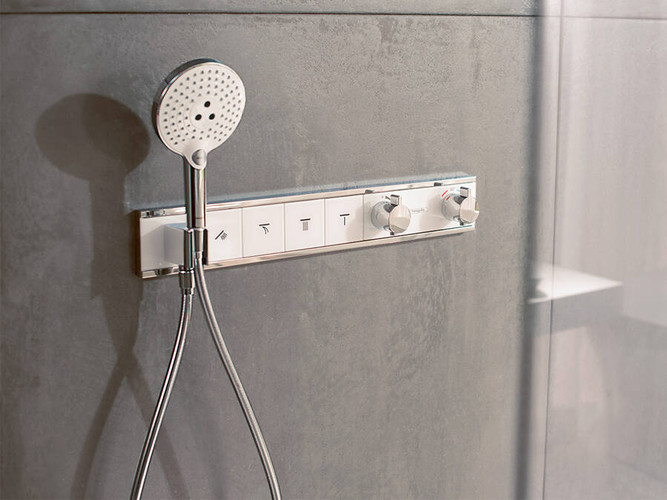
Even if a leaky showerhead does not waste a lot of water or interfere with your showering experience, the leaks can be quite annoying.

There are two possible reasons for a showerhead to leak:
- A faulty head gasket.
- Incorrect connection between the flexible hose and the showerhead.
On the upside, leaks can easily be repaired and the location of the leak can be easily pinpointed.
How to Fix a Leaky Hansgrohe Hand-held Showerhead

Step 1: Remove the Flexible Hose
First, the main water has to be shut off. With an adjustable wrench, undo the fittings (compression) that are both ends of the flexible hose.

Turn the showerhead counterclockwise to unscrew the flexible hose using one hand. If the nut fails to come off, wrap a piece of clothing or a towel on the shower handle and grip it using a pair of tongue-and-groove pliers while loosening, to prevent damaging the color finish of the showerhead.
Step 2: Clean the Threads and Check Them
Check for damages on the plumber’s tape and at the ends of the hose. The flexible hose is usually connected with compression fittings containing rubber washers on both ends. There is usually no plumber’s tape adhering to the threads. However, the compression fittings may be worn out or cracked.
Step 3: Inspect the Rubber Gasket
The showerhead should be unscrewed from the handle. The knurled threaded flange surrounding the perforated showerhead disk should be undone.

For a frozen thread, loosen it using tongue-and-groove pliers after you have wrapped a rag around the knurled section.
Inspect the rubber gasket (large) after you have removed the knurled nut off of it. The gasket is usually fitted inside the cavity that is under the flange. It needs to be replaced if it is hardened or cracked.
Step 4: Soak Off the Mineral Deposits
Use white vinegar to soak all the components of the handheld showerhead for about six to eight hours. This will soften all the mineral deposits that are on the metal. To get rid of the deposits, scrub all the surfaces of the parts using a stiff bristle nailbrush. Use running water to rinse all of the cleaned parts.
Step 5: Tape the Threads
The shower handle has male threads on them. Wrap the Teflon tape on them in a clockwise manner. Pull the Teflon tape until it snaps, and then smooth the ends that are ragged into the threads.
Step 6: Reconnect the Flexible Hose
Screw the flexible hose fitting on the handle. Tighten the nut using an adjustable wrench. Similarly, connect the other end of the flexible hose to the faucet.
Step 7: Install New Rubber Washers
The rubber washers should be inserted into the compression fittings. On the faucet and the showerhead, thread the fittings. Use an adjustable wrench to tighten both of the fittings and be careful not to damage the rubber washers by tightening them.
Step 8: Install a New Rubber Gasket
On the knurled threaded flange, slip a new rubber gasket into the slot. Tighten the knurled nut by hand firmly after threading the flange onto the shower disk.
Step 9: Test the Connections for Leaks

Turn the water supply and the faucet back on to check if there are any more leaks on the Hansgrohe showerhead. If the showerhead continues to leak, turn the compression fittings about ¼ of a turn using an adjustable wrench.
If there is a leak under the knurled nut that is on the showerhead, tighten the nut another ¼ turn using tongue-and-groove pliers. Make sure to wrap a piece of fabric around the fitting before tightening the nut, so that you do not damage the color finish.
Experience the beauty of water with premium bathroom and kitchen products by Hansgrohe. Find more Hansgrohe products here!
Explore More: Hansgrohe brand guide | showers